Dynamic Rupture simulations
Dynamic rupture modeling entails a physics-based characterization of the earthquake rupture process based on first-order principles. Using 2D and 3D numerical modeling codes (e.g. finite-difference, spectral element methods), parameterizing the bulk medium properties, the stresses acting on the fault, and the frictional breakdown process at the propagating fracture, we solve the equations of motion to compute how earthquake ruptures behave under various initial and boundary conditions. Most of these simulations are computationally very demanding and require large-scale computing facilities.
Earthquake rupture dynamics is a rapidly evolving field in earthquake seismology due to the increasing computational resources available. It is also a topic of great importance and social relevance as the details of the dynamic fracture process of an earthquake determine the space-time evolution of the rupture process, and with that the seismic shaking and corresponding secondary effects (e.g. tsunamis, landslides).
Unfortunately, earthquakes generally occur mostly deep in the Earth, and the mechanics of the breakdown process cannot be studied directly. Hence, our knowledge on the details of earthquake rupture dynamics is quite limited. Therefore, numerical simulations are needed, combining fundamental physics with laboratory observations on friction, and testing against seismic observables, to better understand and model earthquake ruptures.
In our group, we use different numerical techniques (spectral elements, finite difference methods) in two- and three-dimensions, and study dynamic rupture properties for linear- and non-linear frictional behavior at the fracture front, or for heterogeneous initial stress conditions on the fault. Our findings demonstrate the existence of different rupture modes (cracks, and pulses; sub-shear and super-shear rupture speed), and transitions between these modes. We also examine dynamic ruptures in the presence of geometrical complexity of the fault, and corresponding effects on the shaking levels at the Earth surface.
Seismic Waves in a Heterogenous Medium
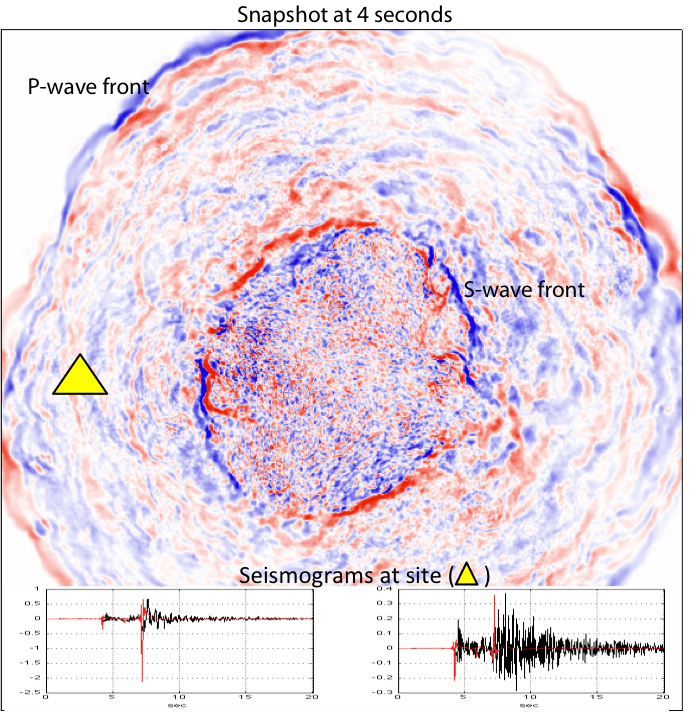
Seismic wave scattering has received increased attention in strong-motion seismology in recent years as broadband simulations of ground motions for earthquake-engineering are becoming more important. Research in the 1980 and 1990 focused on estimating the scattering properties of the Earth from coda waves and other geophysical observations; these observational studies were partially supported with 2D wave-field simulations. Several theories for seismic back-scattering have been developed, based on the observational and numerical results. More recent work favors a model in which seismic forward scattering dominates. While we deploy an empirical back-scattering model in our hybrid broadband simulations, our current work focuses numerical 3D.